
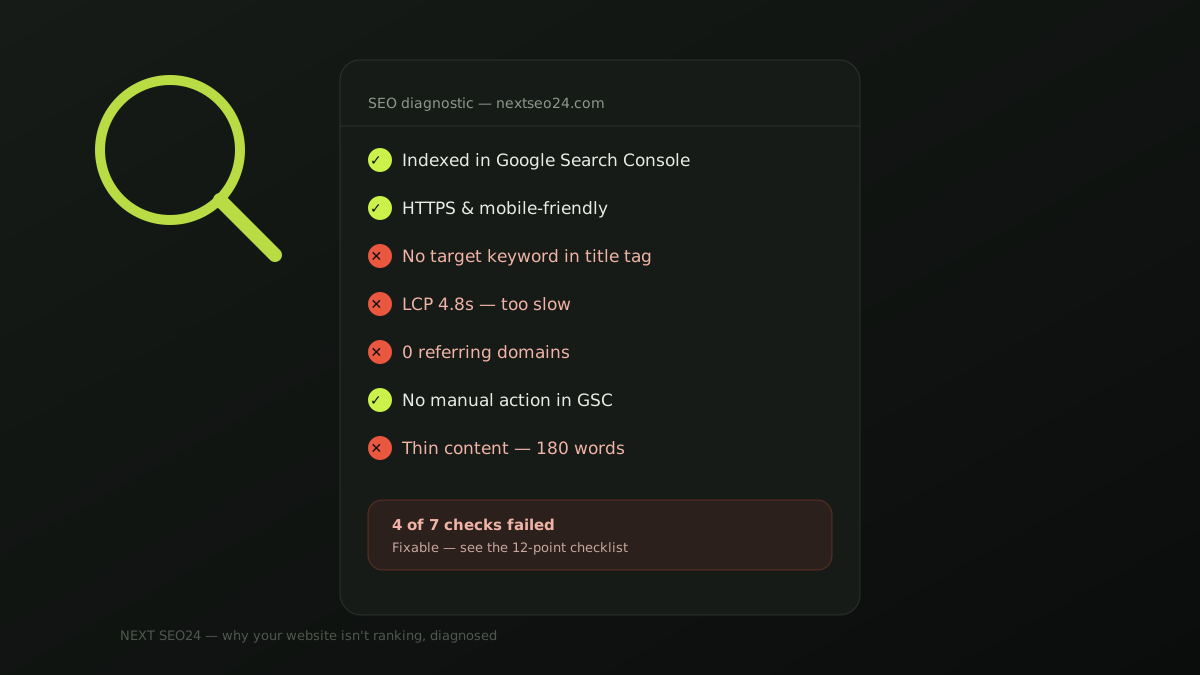
Why isn't my website ranking on Google? 12 real reasons
"We have a website, why does nobody find us on Google?" is the single most common message we get from Malaysian business owners. The good news: it's almost always one of a short, diagnosable list of problems. Work through this checklist in order — most sites we audit are held back by two or three of these at once.
Before diving into individual fixes, understand the order of operations: Google has to find your site, crawl it, index it, and only then can it consider ranking it — the order laid out in Google's own Search Essentials documentation. A problem at any earlier stage blocks everything after it — which is why we've grouped the 12 reasons into three stages below.
Stage 1 — Google can't find or index you
- 1. Your site isn't indexed at all. Check Google Search Console's URL Inspection tool. If it says "URL is not on Google", nothing else on this list matters until this is fixed.
- 2. Robots.txt or a noindex tag is blocking you. A leftover "Disallow: /" from a development site, or a forgotten noindex meta tag, silently keeps pages out of Google entirely. This is one of the most common launch mistakes we find.
- 3. No sitemap submitted, or a broken one. An XML sitemap submitted in Search Console helps Google discover and prioritise your pages, especially on a newer or larger site. A missing or error-filled sitemap slows discovery significantly.
- 4. The domain is too new or has no incoming links yet. Google needs to discover your site through a link or a sitemap submission before it can crawl it at all. A brand-new domain with zero external links can sit unindexed for weeks.
Stage 2 — Google indexes you, but content and on-page signals are weak
- 5. Your target keyword isn't in your title tag. Google still relies heavily on title tags to understand what a page is about. A vague title like "Home" or your business name alone wastes the single most important on-page signal you control.
- 6. Thin or duplicate content. Pages under roughly 300 words with little unique value, or templated content repeated across many pages (common on multi-location or multi-service sites), give Google little reason to rank you over a more thorough competitor.
- 7. Content doesn't match search intent. Ranking for "SEO pricing Malaysia" requires a page that actually discusses pricing — a generic "About our SEO services" page targeting that keyword will underperform no matter how well-written it is.
- 8. Missing or broken structured data. Schema markup (Organization, Article, FAQ, LocalBusiness) doesn't guarantee ranking, but it materially improves how Google understands and displays your page — and its absence is a missed, free opportunity.
Stage 3 — Google indexes and understands you, but trust and authority are too low
- 9. Poor Core Web Vitals. A slow-loading page (high LCP), layout that jumps around while loading (poor CLS), or sluggish response to taps (high INP) directly factors into ranking and quietly costs conversions even when it doesn't.
- 10. Few or no quality backlinks. Backlinks remain one of the strongest authority signals Google uses, especially for competitive keywords. A technically flawless page with zero external links struggles to outrank a mediocre page with genuine authority behind it.
- 11. A manual action or algorithmic penalty. Check the "Manual Actions" section in Search Console. Past spammy link building, keyword stuffing or a hacked site can suppress rankings site-wide until resolved and, where required, a reconsideration request is filed.
- 12. You're simply outmatched on competitive keywords. Sometimes nothing is technically wrong — the keyword is dominated by national brands or established competitors with years of authority. The fix is strategic: target realistic, lower-competition keywords first and build up.
A 15-minute self-diagnosis you can run today
Open Google Search Console and check these four reports in order — they will tell you which of the three stages above is your bottleneck:
- Coverage / Pages report — are your key pages actually indexed?
- Performance report — do you have impressions but very low click-through, or almost no impressions at all?
- Core Web Vitals report — are your key pages flagged "Poor" or "Needs improvement"?
- Manual Actions and Security Issues — any active penalties or warnings?
If you've checked all of this and still can't tell what's holding you back, that's exactly the diagnostic work we do for free before any engagement — send us your website below and we'll tell you plainly what's wrong.
Frequently asked questions
My website is indexed but still not ranking. Why?
Being indexed only means Google knows the page exists — it says nothing about ranking. Ranking depends on relevance, content quality, technical performance and authority (backlinks) relative to every other page competing for the same keyword. Indexing is the minimum requirement, not a ranking factor.
How long after fixing SEO issues will rankings improve?
Technical fixes like indexing or crawl errors can show improvement within days to weeks once Google recrawls the site. Content and authority-related issues take longer — typically 2-4 months to see meaningful movement, since Google needs to reassess quality and trust signals over time.
Can a new website compete with established competitors on Google?
Yes, but not by targeting the same broad keywords immediately. New sites should target lower-competition, longer-tail and local keywords first to build initial authority and traffic, then expand into more competitive terms as domain trust grows.
Want to know exactly why your site isn't ranking?
Send us your website for a free, plain-English diagnostic — we'll tell you which of the 12 issues above is holding you back, and what to fix first. No obligation.
Chat on WhatsApp →