
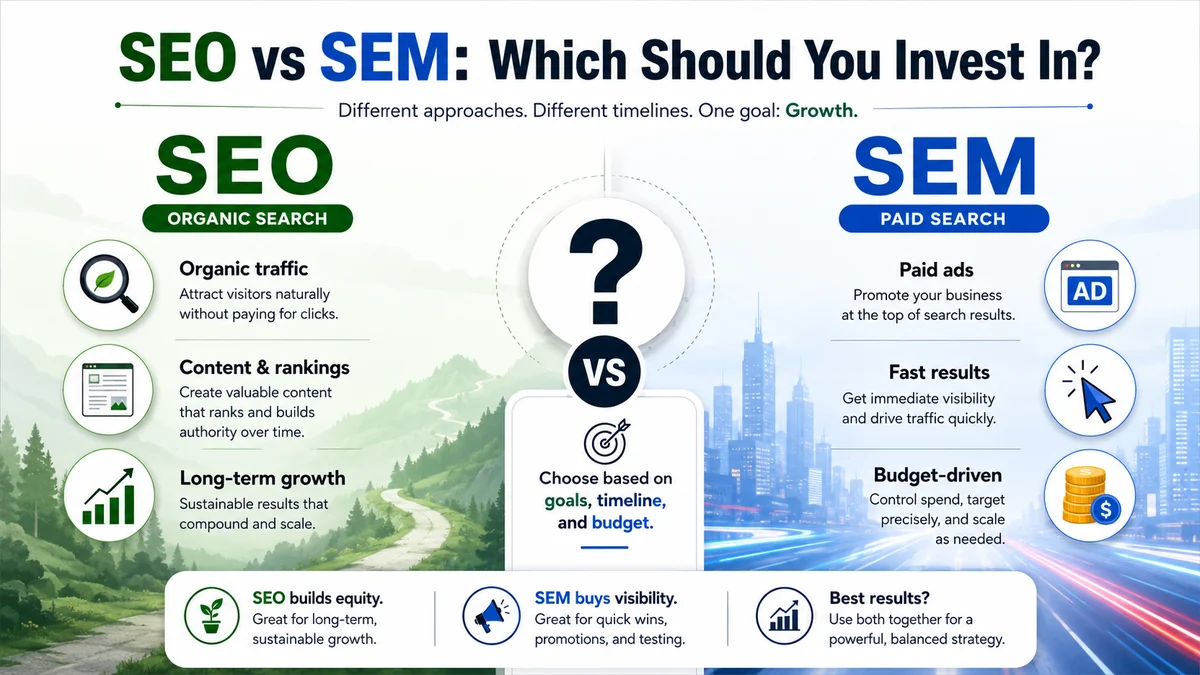
SEO vs SEM: which should you invest in?
Every growing business eventually faces the same question: should we spend our budget on SEO or Google Ads? The honest answer depends on your timeline, competitive landscape, and how long you plan to stay in the market. Here is how to think about it — and why most businesses end up needing both.
What SEO and SEM actually are
SEO (Search Engine Optimisation) is the practice of earning unpaid, organic rankings in Google and other search engines. It involves technical site health, content that genuinely matches what searchers want, and authority signals — primarily backlinks from credible sources. Done well, SEO compounds: a page that ranks today keeps driving traffic next month and next year with no additional cost per click.
SEM (Search Engine Marketing) most commonly refers to paid search — Google Ads in particular — where you bid for ad placements at the top of the results page. You set a budget, define your keywords and audience, and pay each time someone clicks. Results are near-instant: traffic can start flowing within hours of launching a campaign.
The core trade-off
The fundamental difference is in the economics over time. With Google Ads, you rent visibility: the moment you stop paying, you disappear from the page. With SEO, you own visibility: rankings you have earned continue to deliver clicks even when no budget is being spent. That makes SEO a compounding asset and SEM a recurring operating cost.
- Speed. SEM is immediate — ads can go live today. SEO typically takes three to six months to show meaningful traction, and 12+ months to reach full compounding velocity.
- Cost over time. SEM cost scales linearly with every click you receive. SEO has higher upfront investment but a falling cost-per-lead as rankings mature — clicks become effectively free.
- Trust and click share. Studies consistently show that organic results capture the majority of clicks for most queries. Ads are skipped by a large share of users, especially for research-stage queries. Organic rankings also carry an implicit trust signal that paid ads lack.
- Durability. A strong organic ranking is resilient — algorithm updates aside, it is not erased the moment a budget decision changes. A paused ad campaign vanishes immediately.
When to prioritise SEM
Paid search is the right primary channel when speed is non-negotiable. If you are launching a new product and need leads this week, or running a time-limited promotion, SEO cannot help you in that window. SEM is also valuable for testing: you can run ads on a new keyword cluster to validate demand before committing months of content effort. In highly competitive markets where organic rankings take years to build, paid search provides a floor of visibility while the longer game plays out.
When to prioritise SEO
SEO wins on long-term return on investment for almost every sustained business goal. If you are an established brand building for the next two to five years, organic rankings compound and the cost-per-lead falls over time. SEO is especially powerful for informational and research-stage queries — the content that earns trust before someone is ready to buy. It also builds brand credibility in a way that paid ads, by their nature, cannot.
Why most businesses should run both
The most effective strategy is not a binary choice. Use SEM to drive traffic and leads immediately while your SEO foundation is being built. As organic rankings improve, you can reduce paid spend on the terms where you now rank organically, and redirect that budget to competitive keywords where you have not yet earned a position. Over time, your blended cost-per-lead falls, your dependency on paid spend decreases, and your business becomes harder to disrupt. The two channels are genuinely complementary — they do not compete, they reinforce each other.
Frequently asked questions
Is SEO better than Google Ads?
Neither is universally better. SEO delivers compounding, durable traffic at a lower long-term cost per lead, but takes three to six months to build meaningful traction. Google Ads delivers traffic the same day you launch but stops the moment you stop paying. Most businesses benefit from running both: paid search for immediate results while SEO builds the durable base.
Can I do SEO and SEM at the same time?
Yes, and for most businesses this is the recommended approach. Google Ads covers you while your organic rankings are still climbing. Once SEO is established you can scale back paid spend on your top organic terms and redirect budget to competitive keywords where you have not yet ranked.
Which is cheaper — SEO or Google Ads?
Google Ads has a lower upfront barrier but an indefinite ongoing cost — you pay for every click, every day. SEO requires investment in content, links and technical work upfront, but once you rank, those clicks arrive for free. Over a 12–24 month horizon, SEO almost always delivers a lower cost per lead for sustained traffic.
Not sure which channel is right for you?
Get a free, no-obligation review of your search opportunity — we will map out where SEO vs paid search can each drive the best return for your specific business and budget.
Chat on WhatsApp →